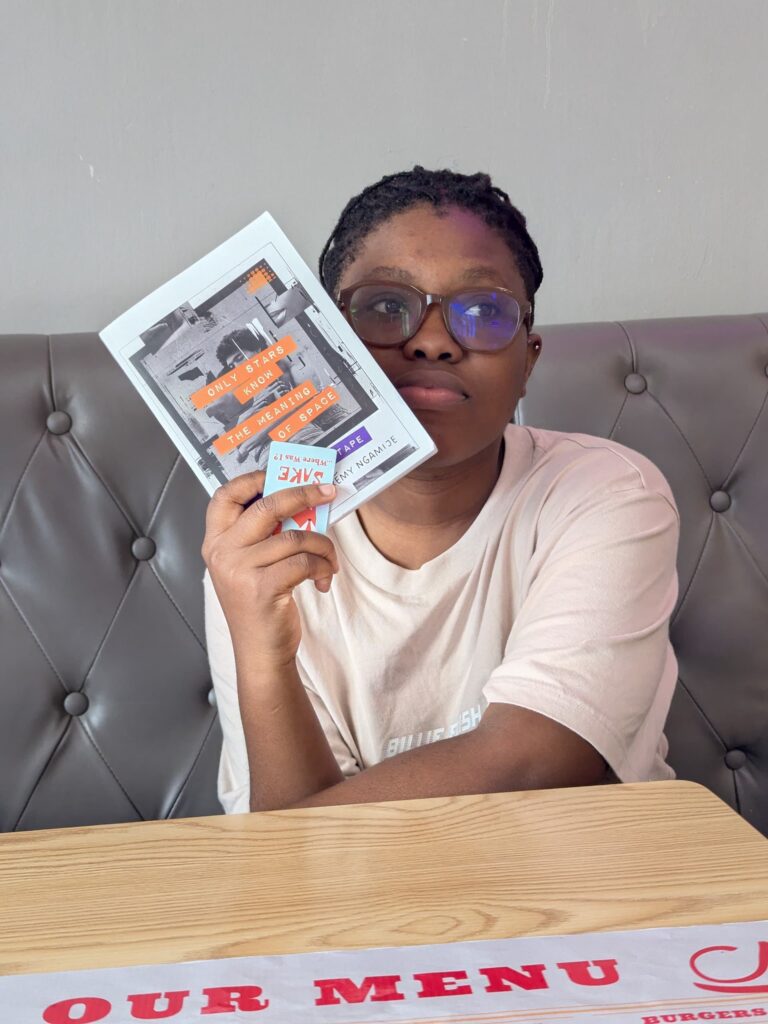
Presented as a literary mixtape, Only Stars Know the Meaning of Space is a work of literature that provides you with a modern reading experience. The A-Side, read as one narrative, tells the story of a soon-to-be thirty-year-old aspiring writer navigating a complicated world. The B-Side, taken as a separate experience, features (seemingly) independent and unrelated short stories.
There’s “Crunchy, Green Apples (or, Omo)”, a story about loss told by the strangest of narrative a shopping list. “Sofa, So Good, Sort Of (or, John Muafangejo)” is a first-person account of a family’s history and a long journey towards hope. A group of friends attempts to navigate a recent breakup in “From the Lost City of Hurtlantis to the Streets of Helldorado (or, Franco).
Although I can no longer, for the life of me, find Nnamdi Ayadu’s profile (another writer on my TBR list), I’ll never forget when he tweeted, “There’s writers who readers enjoy and writers who other writers enjoy. The goal is to be both.” As both a reader and a writer (two things I’m currently failing at), I can attest that Rémy has exceeded that goal.
“I guess if there’s a closet, a negro is always going to find room for another skeleton.”
―Rémy Ngamije, Only Stars Know the Meaning of Space.
From the moment I read “The Giver of Nicknames,” I knew I wanted to read more of Rémy’s work. However, finding books you actually want to read in this country is an extreme sport. So when it came to deciding whether to start with his debut novel or his debut short story collection, The Eternal Audience of One just had to lose to The Literary Mixtape.
Only Stars Know the Meaning of Space (come on, how was I to look away from that title and that cover) is a short story collection that Rémy coins a literary mixtape, and true to the name, there is a musicality to the way this is put together.
“Men are forever ice bergs into which women are doomed to crash into over and over again.”
―Rémy Ngamije, Only Stars Know the Meaning of Space.
Not only is the cover designed in the way of traditional recorded-over cassettes, Rémy organises the stories in an A-Side, B-Side format. The A-Side follows one man, nicknamed Rambo, as he navigates the years before his thirtieth birthday, featuring too many women, a lot of books, a ragtag group of friends he should really question having, and the tectonic event that is his mother dying.
I am tempted to draw parallels and say Rambo is actually just a stand-in for Rémy, but outside of just being a fan and camping on his website, I really don’t know Rémy like that – at all. But even if I can ignore the fact that Rambo migrated to Namibia after being born in another country (can’t remember if it was Rwanda) just like Rémy; or that he is also an aspiring writer like the author; or that his name is conspicuously never mentioned but hinted to start with an R as well; I can’t ignore the intimacy of it. There’s a personalness that just reads like it’s being written straight out of lived experience.
“This is how grief works: it mines your being for guilt and makes it bubble and froth to the fire.”
―Rémy Ngamije, Only Stars Know the Meaning of Space.
On the other hand, we have Side B. This side of the mixtape comprises what one would assume are standalone narratives, but many of them are part of a larger story and weave into elements of what’s happening on the A-Side. There are a few that, except for being set in Namibia, seem to have little to do with the bigger picture – like “Neighbourhood Watch” and “Important Terminology for Military Aged Males,” for instance. If connections were there to be made, I simply couldn’t find them, but that didn’t take away from their enjoyability.
From that you can tell that Rémy’s writing is experimental. (And if you can’t tell then I’m telling you now.) And this is especially befitting because it actually reads like a mixtape – raw, free flowing and defiant of the constraints of what might be viewed as traditional.
Rémy has this way of writing that feels like swirling a whiskey glass – no ice – in a jazz club (I don’t drink whiskey nor do I listen to jazz especially in a club but that’s neither here nor there). It reads like you’re listening to it. Damn near lyrical in its execution. Suave in a way that can only be “triple distilled twice as smooth,” you know?
“ In the great game of love, lust is last place and the consolation prize for participation Is loneliness.”
―Rémy Ngamije, Only Stars Know the Meaning of Space.
I saw a review on Goodreads call the writing confident and energetic. And I had to agree. It is smooth and sensual. It feels young and it feels hip and modern. It’s also witty in a way that only works when you’re clever, and Rémy has proven to be clever indeed. The stories are sprinkled with cultural references that swing wildly from Dragon Ball Z to Humpty Dumpty, from the US Tennis Open to literal Russian chess grandmasters – from the if you know, you know to the if you don’t get it, forget about it. Sharp, tongue-in-cheek, and very distinct.
It’s the type of writing that simultaneously makes me want to write but at the same time makes me realise I can’t write like that ever – unless perhaps I die and reincarnate back as a Rwandan-born Namibian-bred man named Rémy. Personally, I don’t think what was done here can be redone.
Like every short story collection, it has some really heavy hitters. The first story, which introduces the book’s main character, Rambo, is a true masterclass. I’ll be the first to admit I didn’t fully follow it (the writing style demands a lot) but I got the gist of it. And despite some things going over my head, I still think it’s an excellent read. 5/5. It’s a strong start to the collection. A good introduction into the type of writing and stories you’re getting into.
“Love truly is for morons.”
―Rémy Ngamije, Only Stars Know the Meaning of Space.
In general I loved the A-Side stories more, though the B-Side definitely had many strong contenders as well. Despite Rémy and the protagonist being men – hence making this collection very male in a way I can’t relate to – the emotional range of the stories still pressed on something very familiar, soft and sore. There’s an ache to many of the stories and characters that’s just too real not to relate to.
An example of this is “Crunchy Apples (or, Omo)”, which shows us the relationship Rambo had with his mother through a grocery list (of all things.) This almost made me cry because I was reminded of something I read a long time ago that went something like, “nothing hurts more than being mean to your mom and realising later.” I thought of my own mother (still alive at the time of writing this – thank God) and how, at the end of the day, even she’s still an African mom, and how certain experiences are universal regardless of which side of the continent you’re on.
“ It seemed to me as though sanity was the only true possession a black person could own and even it was under attack every day from whitewashed glossy magazine covers.”
―Rémy Ngamije, Only Stars Know the Meaning of Space.
If it hasn’t been clear already, another strong suit of this collection is how Rémy experiments with form, style, perspective and just about literally everything. The grocery list as a vehicle for a mother-son dynamic is just one example. There’s also “Seven Silences of the Heart,” a B-Side story narrated by the bitter soul of a miscarried baby. This one also perfectly exemplifies what I mean when I say the B-Side seems to be part of a larger narrative too, because you get the sense that this baby might be Rambo’s mother’s first child.
Outside of choices in narrative devices, Rémy plays around with structure as well. “Tornado (or, the Only Poem You Ever Wrote)” is literally a poem that’s not a poem. It is actually shaped like a tornado and the last couple of lines are a gut punch (if you know, you know). Another example of this is “Important Terminology for Military Aged Males” which – I kid you not – explains the South African Border War (or the Namibian War of Independence) in the format of A as in Apple, except the phonetics are the racial and political dynamics of the era. K, for instance, is Kaffir – which, in case you didn’t know, is a slur for black people. Every sentence in this one begins with “as in” or “or” to fit the motif. It doesn’t quite make sense to describe. You’d just have to read it.
But my favourite way in which Rémy played with form is in “Annus Horribilis.” The title is a Latin phrase for “horrible year,” used to describe a period of misfortune. This story catalogues every single month of a couple’s first year together and is literally just one long sentence for three pages punctuated by brackets. I remember reading that and thinking, how does one just think to do such a thing – and then, how does one pull it off. How audacious.
“It is easy to remember the sound of bullets when they don’t hit you.”
―Rémy Ngamije, Only Stars Know the Meaning of Space.
That said, like all short story collections (and all writing in general), some weaknesses do exist. Not all the short stories were masterpieces. Some read like filler and others I have forgotten already. I also feel that sometimes Rambo’s voice bleeds into stories that aren’t his. Several B-Side stories, which should by design be introducing entirely new characters and worlds, end up sounding a little too much like him. I think this shows a lot in the story “The Other Guy,” whose narrator could very well be some rival to Rambo, someone not even remotely tied to him or Rambo himself at this point. Additionally, Rambo’s own stories sometimes seem too repetitive, hitting all the same beats to the point where I’ll likely confuse a few of them later.
And this might just be the cynic in me, but most of the stories seem hopeful in ways that feel unearned. The undertone of it seems almost manufactured, especially since the lesson sometimes arrives both abruptly and heavy-handedly. Though the story was alright, I felt this a lot in “Yog’hurt (or, Just Breathe)”.
“They dreamed of you when dreams were all they could afford.”
―Rémy Ngamije, Only Stars Know the Meaning of Space.
However, not resonating with this in particular probably says more about me than the quality of the collection. The idea of hope is an intentional thematic through-line rather than a misstep. Especially when you consider the final story, “Sofa, So Good. Sort Of.” This story ties it all together. It reads like a thesis statement for the entire collection, which I can only sum as this: “Life is messy and often disappointing but somehow, despite everything, we gotta keep going. So far, so good. Sort of.” Or as Von Goethe put it “In all things, it is better to hope than to despair.”
In the end, I rated every single story between 3 and 5 stars. Which means even the ones I’ve already half-forgotten were pretty good. I had a great time reading this – the kind of great time that can’t go unrewarded. I’ll definitely come back to this mixtape someday. Even soon perhaps. For now, 5/5 stars- flaws and all.



Pingback: Anna Karenina - a review | Tamanda Kanjaye