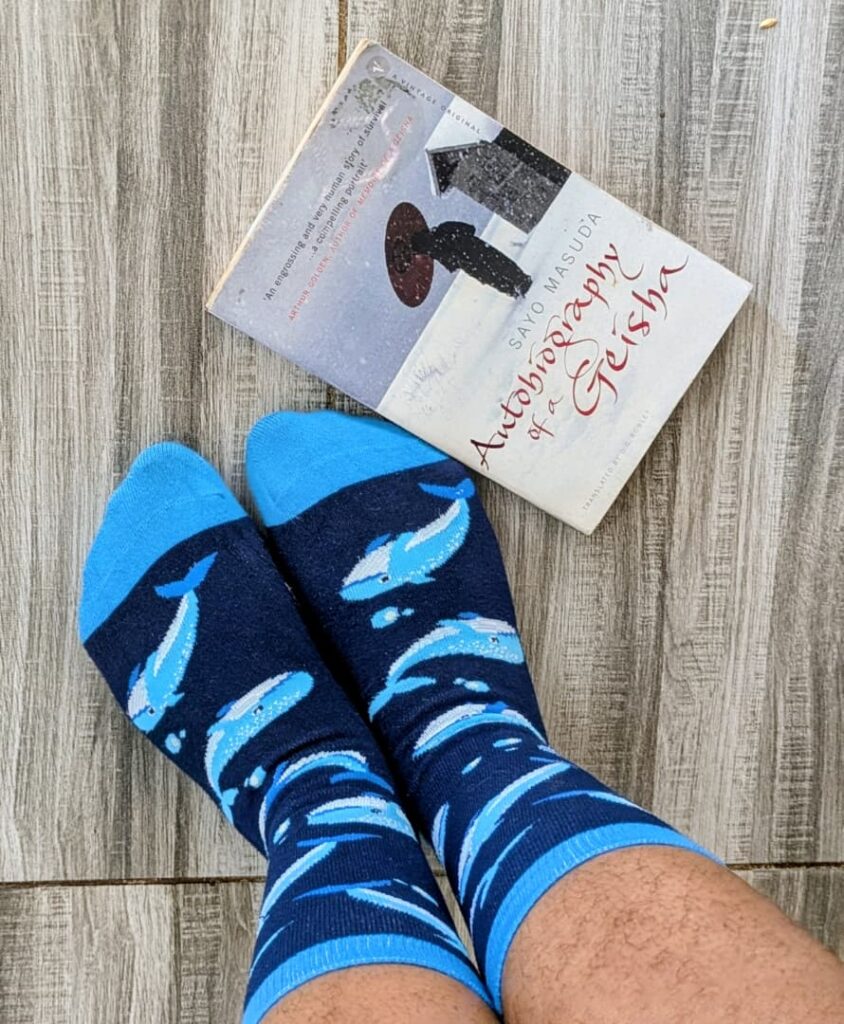
Sayo Masuda was a geisha at a hot springs resort, where the realities of sex for sale are unadorned by the trappings of wealth and power. Remarkable for its wit and frankness, the book is a moving record of a woman’s survival on the margins of Japanese society—in the words of the translator, “the superbly told tale of a woman whom fortune never favored yet never defeated.”
I have never read the famous Memoirs of a Geisha by Arthur Golden and honestly probably never will. I’m not really all that interested in geisha culture and only bought this book because I, in my own way, found it funny to have an imaginary conversation where by someone asks me if I’ve read “Memoirs of a Geisha” and I answer, “no, but I’ve the autobiography of one.”
Despite my lack of interest though (and questionable sense of humour), I’m not oblivious to the fact that Golden’s account offers a very romanticised and glamourised version of geisha culture – riddled with white washed inaccuracies and real life lawsuits that I didn’t really get into.
In every human heart is a place where you put your broken dreams.
― Autobiography of a Geisha, Sayo Masuda
However, Sayo Masuda offers a real account that veers off what Golden described. There is nothing romantic or glamorous about the story she tells us. Her life is marred by all sorts of horrors, ranging from what I can honestly describe as child trafficking (being sold to a geisha house), child abuse, all forms of human suffering, attempted and actual suicide and everything in between. Despite Masuda very much living up to the old age of 83, this books starts and ends with struggle. It is a litany of personal hardship I cannot even begin to imagine enduring.
Surprising though, Masuda recounts her life in a way that is devoid of any self-pity. She tells her story as one would tell you about the weather – with an unsentimental matter-of-fact detachment.
Being in love isn’t the only way of loving.
― Autobiography of a Geisha, Sayo Masuda
Masuda was born into extreme poverty in rural Japan in the 1920s and was essentially sold as a child into a geisha house in Suwa by her mother and uncle. Life in the house was also marked by bullying from her handlers, patrons and fellow geisha, though she managed to form some meaningful relationships along the way. She spent five years in that house learning to sing, dance, and entertain men.
She describes it plainly as a form of indentured servitude, where debt bondage kept geisha trapped and were expected to provide sexual services alongside entertainment. However, despite the title, we actually spend relatively little time in the story with her as a geisha. Instead, she was eventually bought out of the geisha house and became a mistress to a man, which offered her temporary stability but quite a lot of misery.
Sexual initiation was not nearly as bad as being hungry or in pain.
― Autobiography of a Geisha, Sayo Masuda
She later left that relationship and faced yet more litanies of hardships, drifting through various jobs, including working as a waitress and even selling suspicious soap of questionable legality, all the while navigating life, love and loss. Through most of the narrative, we are must watch front and center the ongoing battle between Masuda’s commitment to survive and desire to die. In the end though she seems to find some sort of peace and that’s the least I could have hoped for her.
I make a point of accepting whatever kindness people show me.
― Autobiography of a Geisha, Sayo Masuda
It’s an interesting story – if you are interested in reading heartbreak after heartbreak – but it is not very well written. There’s literally no flow and at times can be extremely random. It is not the sort of writing that will win any sort of awards. Of course I will cut the author some slack because she was not educated and was barely literate. The translators note also says, they tried to leave it as unpolished as possible, telling the story in Masuda’s “own” words. Considering this, one would argue that this structural choice makes the narrative more authentic, perhaps even endearing, but it won’t be me making that argument.
It’s also not extremely detailed if you’re looking to know the true intricacies of geisha culture. But if you’re a novice like me, it will provide you with knowledge and insights you didn’t previous have. 3/5 barely recommendable stars.
When people think only of themselves, that’s when they are most unhappy.
― Autobiography of a Geisha, Sayo Masuda