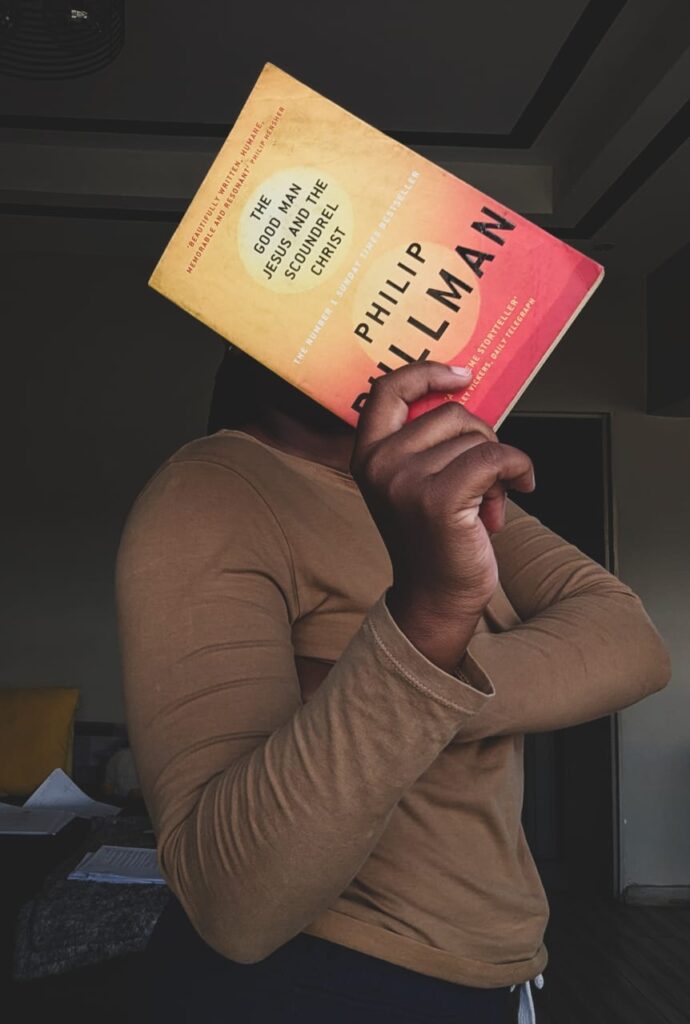
This is a story. In this ingenious and spell-binding retelling of the life of Jesus, Philip Pullman revisits the most influential story ever told. Charged with mystery, compassion and enormous power, The Good Man Jesus and the Scoundrel Christ throws fresh light on who Jesus was and asks the reader questions that will continue to resonate long after the final page is turned. For, above all, this book is about how stories become stories.
Gangs and Girlies,
In what could be his most controversial book (though I’ve never read any else), Philip Pullman asks the question that would have been the 2010 DSTV history channel’s wet dream: What if Jesus had an evil twin brother? Okay, evil is a stretch but, perhaps, misguided (?) conflicted (?) – but definitely not a scoundrel. And if that sounds like blasphemy to you and upsets you, do not pick this book up.
For the most part, this is the Jesus story. And given the fact that I am catholic and I already know the Jesus story, there wasn’t much here that caught me off guard. However, I can’t deny retelling the story from the lens of a twin is an interesting choice because why would anyone even have that thought – but at the same time, why wouldn’t they. Jesus is framed as a fanatical activist who accidentally acquires a gathering. Christ, on the other hand, is his intellectual brother who rewrites a sensational account of his life.
And rewrite he does. Driven by the encouragement of a stranger – who could literally be an angel, the devil or a vehicle of church depending on your interpretation – Christ misconstrues and embellishes the Jesus story and justifies it as being for the greater good.
“There is time, and there is beyond time. History belongs to time, but truth belongs to what is beyond time. In writing of things as they should have been, you are letting truth into history. You are the word of God.”
―Philip Pullman, The Good Man Jesus & The Scoundrel Christ.
The stories of the temptation, the transfiguration, various parables and teachings are presented differently, hinting that Christ doctored them into the versions we know from the Bible. Even the Judas story doesn’t really exist in this one. The betrayal falls to Christ who is prompted by the “do it for the greater good” angel/devil stranger I mentioned before. Which is interesting especially given that it is also Christ and not the devil that tempts Jesus in the Wilderness.
My favourite reimagination of these reinterpretation is of Jesus in the garden of Gethsemane. Pullman’s rendering of this scene is chef’s kiss. As much as we all know the version in which he asks to be relieved of the cup of his suffering, Pullman ups this frustration and uncertainty tenfold. In this story, Jesus does not resign to “your will be done.” Instead he despairs at God’s silence in such a visceral yet relatable way. In that scene, he is not the son of God that the masses have purported him to be. He is just a man who has given everything, asking for some sign, and getting nothing back. It was the most moving part of the book for me.
“Human life is difficult; there are profundities and compromises and mysteries that look to the innocent eye like betrayal.”
―Philip Pullman, The Good Man Jesus & The Scoundrel Christ.
And then, much as in the Bible, Jesus is captured right after this scene, taken to an unfair trial and crucified. Only that, he does not resurrect. He dies a real death, and the angel/devil stranger is the one that orchestrates the moving of his body as Christ witnesses slightly horrified and confused. However, the angel/devil stranger convinces him yet again that this is all part of the greater good plan.
Christ is mistaken for Jesus after his death and reluctantly goes along with it. The foundation of Christianity, in this retelling, is just a case of mistaken identity. And in so doing, Pullman asks a question that has plagued historians, atheists and theologians alike for eons: What if the Gospel accounts are less eyewitness testimony and more just editorial decisions?
“As soon as men who believe they’re doing God’s will get hold of power, whether it’s in a household or a village or in Jerusalem or in Rome itself, the devil enters into them.”
―Philip Pullman, The Good Man Jesus & The Scoundrel Christ.
It is obvious that Pullman has disdain for organised religion, but it never spills into vitriol. He uses Christ and by extension the angel/devil stranger as a vehicle for criticising the path the Church has taken – an institution that inflated a tale into something mythic to consolidate its power. You start to wonder, huh, perhaps the Catholic Church is a bit radical. Which honestly isn’t even that radical an idea.
Jesus having a twin makes you see all his actions such as feeding the thousands bread and fish, turning water into wine and healing the sick from an eye witness who has a realistic stance on the whole thing hence making these events lose all mystic. Again it begs the question whether any of what happens in organised religion captures Jesus’ true ministry, or whether that ministry was lost the moment someone started writing it down with an agenda.
“Lord, if I thought you were listening, I’d pray for this above all: that any church set up in your name should remain poor, and powerless, and modest. That it should wield no authority except that of love. That it should never cast anyone out. That it should own no property. That it should not condemn, but only forgive.”
―Philip Pullman, The Good Man Jesus & The Scoundrel Christ.
Although Pullman openly states he abandoned religion, I don’t know think he is trying to destroy faith so much as to interrogate it and the machinery built around it. In the afterword, he closes by directly asking a question that has stuck with me since putting the book down: if you could have saved this poor man (Jesus) from his fate, would you? And if you believe it was better that he die — for salvation, for the story, for the Church — then how exactly are you different from Judas?
It’s an easy and interesting read if you can set aside some Christian sensibilities – which, fair warning, is doing a lot of heavy lifting depending on who you are. 3.25/5 stars from me. Would definitely recommend to people who have questions about morality, like to deconstruct religion or enjoy debating the Trolley Problem at parties. Would not recommend to anyone who thinks this sounds like blasphemy. You will not enjoy yourself.
“To ask the question and wait for the answer is to know that there will be no answer.”
―Philip Pullman, The Good Man Jesus & The Scoundrel Christ.