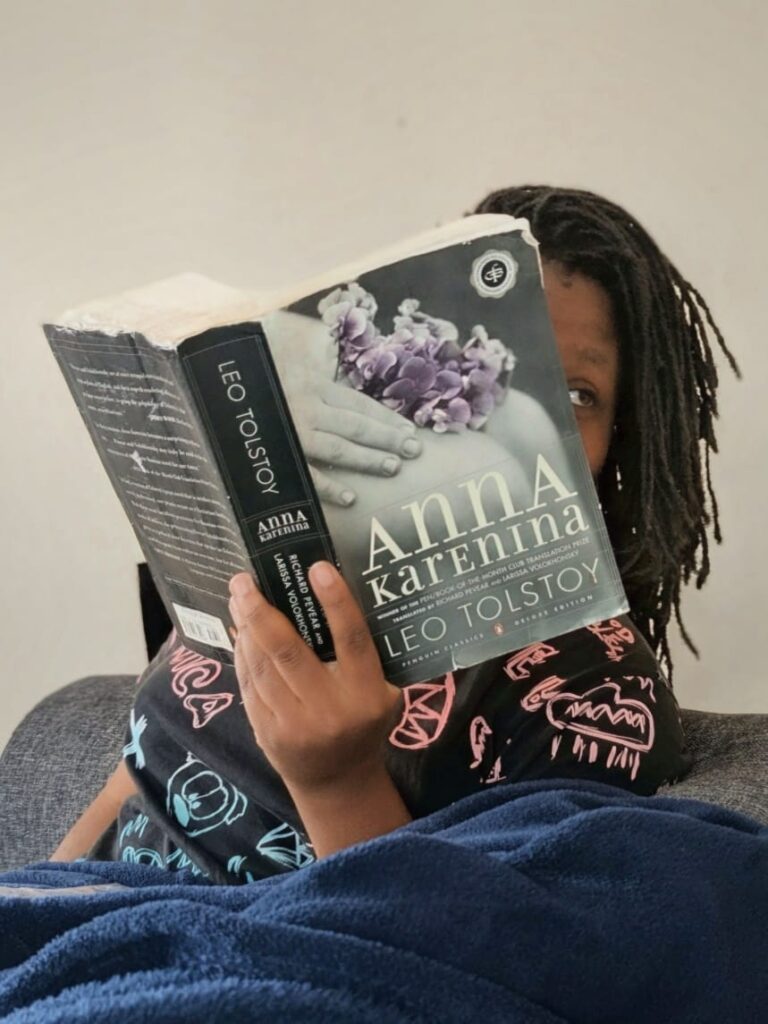
Acclaimed by many as the world’s greatest novel, Anna Karenina provides a vast panorama of contemporary life in Russia and of humanity in general. In it Tolstoy uses his intense imaginative insight to create some of the most memorable characters in all of literature. Anna is a sophisticated woman who abandons her empty existence as the wife of Karenin and turns to Count Vronsky to fulfil her passionate nature – with tragic consequences. Levin is a reflection of Tolstoy himself, often expressing the author’s own views and convictions.
Throughout, Tolstoy points no moral, merely inviting us not to judge but to watch. As Rosemary Edmonds comments, ‘He leaves the shifting patterns of the kaleidoscope to bring home the meaning of the brooding words following the title, ‘Vengeance is mine, and I will repay.
I do not know what possessed me to decide to read 800 pages of a book. (I do – clout and the now regrettable decision to buddy read with a friend who is quite familiar to reading large and large books but also somehow managed to abandon me throughout this ordeal. Curse you Nkhuwemi). Still, I can’t say I quite regret undertaking this feat.
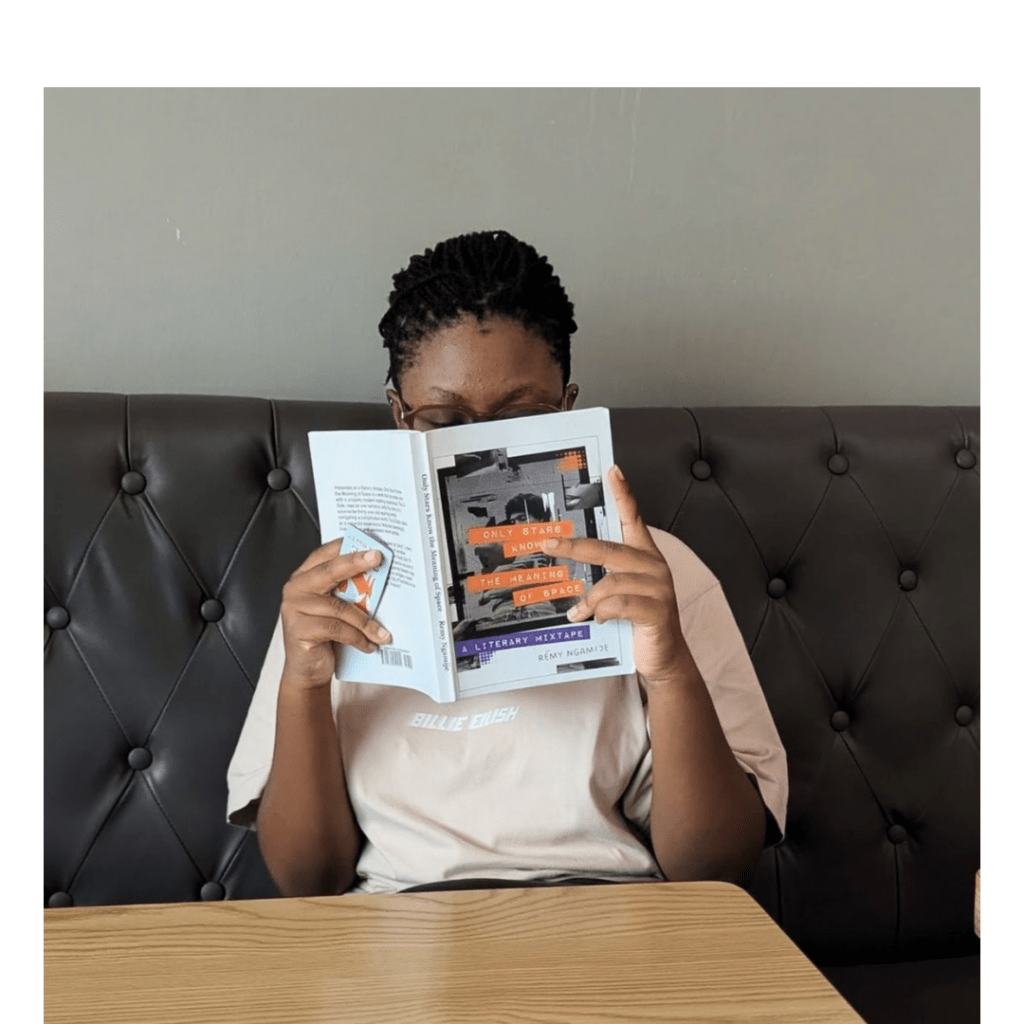
I initially didn’t feel like reviewing it but imagine reading this hunk of papers and not having anything to say about it to the interwebs. Nope. Not me. That would be the equivalent of climbing Mount Everest and not telling anyone about it. In his short story (sorta) collection, Remy Ngamije has a character who describes reading Tolstoy as a chore but yet finished War and Peace and enjoyed telling people he did. And same. I must now go on and tell people that do not care that I conquered this mammoth of book.
Rummaging in our souls, we often dig up something that ought to have lain there unnoticed.
― Leo Tolstoy, Anna Karenina
I think I knew the first line even before I knew the books itself. And I think of it often : All happy families are alike: each unhappy family is unhappy in its own way. I can’t deny that this is a clever line. It has withstood the test of time and I think is testament to the fact that Tolstoy can write. It’s shame that half the time in I found myself wondering what the heck are these people even talking about because I cannot take away the fact that the writing itself is vivid and imaginative and that technically it is good (for the most part). But my good Lord does it meander.
The story starts with the revelation of an affair (the first and actually least important) that throws the home of Stepan Arkadyich into disarray but quickly (relative to what else goes on in this book) the story descends into a spiralling saga of an ensemble cast of characters – who can be called anything at any given time – doing and saying literal fuckall. Someone looked me in the eye and told me that in this day and age, Anna Karenina is their favourite book and I honestly cannot bring myself to believe them.
No matter what the title tells you, this story does not actually center around a woman named Anna Karenina. Don’t get me wrong she’s very pivotal to the story. Actually at its core this story is about an adulterous love affair, with her at the centre, that shakes the Russian Aristocracy. But like I could argue the titular character is secondary to the story. I could even argue that the main character is a man named Konstantin Levin (more on that later).
I work, I want to do something, and I’ve forgotten that everything will end, that there is – death.
― Leo Tolstoy, Anna Karenina
What this book really is about is a compendium of intellectual conversations about just everything really. So dense are these conversations, that range from religion to the meaning of life to freaking land reform, that I really could not keep up with what was going on. When it’s not doing rambling about this, the pages go on and on about hunting of birds, selling of trees, riding of horses and the literal mowing of long grass that I personally can’t believe I had to go through. Still it would be an injustice not to tell you what the plot is when it tries to be less about these things and more about the title.
Though there are many pages before it, and many pages after it, (and many pages during), this story starts and ends with Anna and a train. Anna is on her way to St Petersburg after convincing her sister in law forgive her brother for cheating (the first affair I mentioned) when she bumps into one Alexei Vronsky. Vronsky is handsome and charming and exactly the type of man Bob Marley warns you about. He flirts with a woman named Kitty, awakening her love with no real intention of loving her. Instead, Vronsky becomes infatuated with the very lovely but also very married Anna. And against every single reasonable instinct she has, Anna becomes infatuated right back. Mind you Anna was somewhat friends with Kitty when all this happened. Also, Vronsky literally has the same first name as Anna’s husband. What a mess.
Anyway, a bunch of things happen in this particular plotline, including but not limited to: Anna’s husband growing predictably estranged, her and Vronsky having a child, them eloping to Italy where his art career fails spectacularly, them returning to Russia where her social life fails just as spectacularly due to high society deciding she’s a ruined woman.
These joys were so small that they could not be seen, like gold in the sand, and in her bad moments she saw only griefs, only sand; but there were also good moments, when she saw only joys, only gold.
― Leo Tolstoy, Anna Karenina
After this, Anna becomes more and more unhinged as she battles isolation but also the jealousy she feels due to her unfounded suspicions that Vronsky has found another love. Vronsky on the other hand, though still claiming to be in love, grows less and less infatuated by Anna and more and more frustrated with her actions and spends less and less time at home, feeding back into Anna’s suspicions. This becomes a vicious cycle that continues to spiral and ultimately ends in a trainwreck (if you know, you freaking know). Honestly, taking 800 pages to tell me not to leave my boring marriage for a whirlwind romance in Italy is crazy on Tolstoy’s part.
However despite all this happening, somehow Anna manages to take a backseat in her own story to Konstantin Levin – which makes sense when you realise this character is a self insert of Tolstoy himself (right down to the fact that Levin is 34 when he marries his 18 year old wife). Perhaps this is why Tolstoy writes so fondly of him. In fact Levin’s opinions or lack thereof take a forefront in those philosophical discussions I was talking about. What you need to know about Levin is that he is a wealthy land owner who is searching for meaning in life, and also for how not to exploit his farmhands. We spend a great deal of time with his thoughts and wow, how many thoughts he has.
I’ve always loved you, and when you love someone, you love the whole person, just as he or she is, and not as you would like them to be.
― Leo Tolstoy, Anna Karenina
Outside his many monologues, debates and introspections we also get to see Levin grow. The novel introduces Levin by instantly letting him suffer rejection from Kitty who he has been vying for for ages as she is temporarily dazzled by Vronsky. Sad and heartbroken he retreats to his estate where he throws himself into farming and manual labour as a way of avoiding the bigger questions he doesn’t have answers to yet. Eventually Kitty returns to his life, after she is in turn also technically rejected by Vronsky, and the two wed.
All through this Konstantin faces many internal trials and tribulations as he finds that his philosophical framework for the machinations of life continue to crumble. So deep is his existential restlessness that he temporarily considers suicide (like every other character in this narrative). Then one day, it just stops. He finds an answer in a thrown away comment that eases all his anxieties. That the meaning of life cannot be reasoned into, it can only be lived into. He realises it is futile to look for meaning in philosophy and intellect but to instead start looking for it in simple goodness and the care of others.
First, he decided from that day on not to hope any more for the extraordinary happiness that marriage was to have given him, and as a consequence not to neglect the present so much.
― Leo Tolstoy, Anna Karenina
Konstantin Levin and by extension his relationship with Kitty act as a foil to Anna and her relationship with Vronsky. Where the latter’s burns bright like a supernova and hence could not help but destroy itself, the former is not driven by unsustainable passions but perhaps by true understanding and love. And this perhaps is because of a difference of characterisation. Levin’s arc does not follow one of tragedy. He comes to satisfying answers and does not answer the call of the void like Anna does.
Despite this profound idea though, Levin’s parts and to a greater extent, the entire book, was not as exciting as Anna’s (which in itself also fizzles out) and absolutely tedious. Tolstoy treats this book less like an actual story and more like a vehicle to share his own thoughts on a myriad of topics. It is like he is playing a never ending game of chess with himself and I, as a reader, am being held hostage – tied hands and eyes taped open – to watch it.
I think… if it is true that there are as many minds as there are heads, then there are as many kinds of love as there are hearts.
― Leo Tolstoy, Anna Karenina
There were months on end that I left this book alone and wondered if I would get back to it. If even the author himself found the task of finishing the novel a gruelling task, who am I to think otherwise. My thoughts towards this book lean more closely to how Tolstoy felt towards the end of writing this. In his words, he described it as “a bore” and “insipid as a bitter radish.” Like him, I also intended to abandon it due to an agonising state of mind and a growing to hate it, but still finished it unwillingly.1
And yet, many people refer to this as the greatest novel of all time. The only way I could accept that claim is if they meant in terms of length and not subject matter. But that wouldn’t even be true, because Tolstoy’s own War and Peace supersedes it. I think I should just come to accept that this is yet another beloved book that didn’t do it for (I’m looking at you Kite Runner). Yet another book that makes me question whether I have taste or not. 3 unrecommendable stars out of five.
The doctor explained that the illness came from fatigue and worry, and prescribed inner peace.
― Leo Tolstoy, Anna Karenina
you probably wrote ‘finish what you start’.
even the books you did not like, you manage to give good reviews. I admire your patience and commitment. my pile of unfinished books would be taller than Mt. everest surely. 😂
Thanks! I’m actually trying to learn when to leave something and when to continue. I’m trying to also read books I actually own. I will conquer that mountain one day as well.